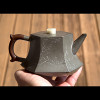
Yes, I use it fairly often for gaoshan oolong because it's thin and the size is on the larger end of things. Late Qing/ early ROC zhuni is nicer but often a bit thicker, thinner ones are often smaller, thinner and larger ones I haven't seen for under $3000 usd
Yixing
I think I have a similar problem like @Mark-S
I recently just collected my 3rd specimen pot for reference. I think all three pots are commoner pots that were exported to the west about a hundred year ago. My most recent pot even have 2 holes that make the pot unusable
I am planning to see if I can get a staple to plug those two holes. Anyone have any staple repair pots care to comment on leakage?
@DailyTX depends on the hole... if it’s too large I’d consider Kintsugi. There are specialists for other than staple and Kintsugi in China, but I doubt it’s worth the commoner pot and their workflow is probably not that smooth at the moment 
I was just about to get some staples done, when the first rumours of the outbreak came in, lucky I didn’t send it out...
@BokBok wrote: ↑Wed Mar 11, 2020 7:20 pmDailyTX depends on the hole... if it’s too large I’d consider Kintsugi. There are specialists for other than staple and Kintsugi in China, but I doubt it’s worth the commoner pot and their workflow is probably not that smooth at the moment
I was just about to get some staples done, when the first rumours of the outbreak came in, lucky I didn’t send it out...
yeah...not much financial value for this pot, and definitely not worth sending it in to a specialist for repair. Since the pot worth a few cups of coffee, even if I break the pot during the self repair process, my wallet won't feel the pain
Talking about the repair, the holes are quite interest. From what I can imagine, it seems when the maker was making the 6 holes filter, the tool went too deep and stabbed the surface where the sprout and the bottom connects, and it left 2 bumps after firing. After long time usage, the surface of the bumps slowly wear out and became 2 tiny holes. However, this still doesn't make sense because modern artist typically drill the filter holes prior to installing the sprout. Unless installing the sprout then drill filter holes was a practice back in the days
Could you snap a shot of it? Sounds like it would be an easy repair, relatively idiot-proofDailyTX wrote: ↑Wed Mar 11, 2020 9:46 pmyeah...not much financial value for this pot, and definitely not worth sending it in to a specialist for repair. Since the pot worth a few cups of coffee, even if I break the pot during the self repair process, my wallet won't feel the pain![]()
Talking about the repair, the holes are quite interest. From what I can imagine, it seems when the maker was making the 6 holes filter, the tool went too deep and stabbed the surface where the sprout and the bottom connects, and it left 2 bumps after firing. After long time usage, the surface of the bumps slowly wear out and became 2 tiny holes. However, this still doesn't make sense because modern artist typically drill the filter holes prior to installing the sprout. Unless installing the sprout then drill filter holes was a practice back in the days![]()
I would say it's a super easy repair lol, at one point I was thinking should I just jam a grain of rice thereBok wrote: ↑Wed Mar 11, 2020 9:53 pmCould you snap a shot of it? Sounds like it would be an easy repair, relatively idiot-proofDailyTX wrote: ↑Wed Mar 11, 2020 9:46 pmyeah...not much financial value for this pot, and definitely not worth sending it in to a specialist for repair. Since the pot worth a few cups of coffee, even if I break the pot during the self repair process, my wallet won't feel the pain![]()
Talking about the repair, the holes are quite interest. From what I can imagine, it seems when the maker was making the 6 holes filter, the tool went too deep and stabbed the surface where the sprout and the bottom connects, and it left 2 bumps after firing. After long time usage, the surface of the bumps slowly wear out and became 2 tiny holes. However, this still doesn't make sense because modern artist typically drill the filter holes prior to installing the sprout. Unless installing the sprout then drill filter holes was a practice back in the days![]()
![]()
I'll post a photo this weekend.
@Bok
Have you heard of artists installing sprout first before drilling filter hole? Or did I came across a pot make by idiot? lol
Maybe someone here can shed light on this. I am pretty sure that this is a F1 pot. I could not find a similar one online, but the clay and craftsmanship look like F1 to me. Today, I noticed that the handle has got a seamline. In which cases does this indicate slipcasting? This cannot be slipcasting imho. Thanks in advance 
- Attachments
-
- IMG_20200312_105526108-01.jpeg (163.31 KiB) Viewed 8511 times
-
- IMG_20200312_105316270-01.jpeg (95.86 KiB) Viewed 8511 times
I’d say it indicates that the handle was made with the help of a mould. Which makes sense for mass production.Mark-S wrote: ↑Thu Mar 12, 2020 5:11 amMaybe someone here can shed light on this. I am pretty sure that this is a F1 pot. I could not find a similar one online, but the clay and craftsmanship look like F1 to me. Today, I noticed that the handle has got a seamline. In which cases does this indicate slipcasting? This cannot be slipcasting imho. Thanks in advance
![]()
As to era, I’ll let others comment ornament pots are not my forte.
@Bok
+1
If no other signs of slipcasting, then it means, that the handle was molded too.
Probably faster to make this style of pot, than to handmade the handle.
+1
If no other signs of slipcasting, then it means, that the handle was molded too.
Probably faster to make this style of pot, than to handmade the handle.
And how do you know that this handle was made using a mold and the other handle was made by slipcasting? Sorry, if this a stupid question, but I do not see a pattern here.
- Attachments
-
- Slipcasting
- IMG_20200312_130548227-01.jpeg (180.96 KiB) Viewed 8497 times
@Mark-S slipcast handle will have a dent on the inside corresponding to where the handle comes out. Look at an average plastic plant watering can and you see the same principle!
Also slipcast will never have such crisp details.
The rest is just experience of having seen a fair lot of both making methods.
Also slipcast will never have such crisp details.
The rest is just experience of having seen a fair lot of both making methods.
-
Chadrinkincat
- Posts: 902
- Joined: Mon Dec 04, 2017 8:16 pm
- Location: Brooklyn, NY
- Contact:
@Mark-S
This pot could be green label era.
Seam lines on these decorative designs are the norm for F1/F2 so It doesn’t indicate your pot is slip cast. Here is one example of it on an authentic green label pot.
This pot could be green label era.
Seam lines on these decorative designs are the norm for F1/F2 so It doesn’t indicate your pot is slip cast. Here is one example of it on an authentic green label pot.
- Attachments
-
- 91E37702-7E32-40E4-998F-30C65DFF26EE.jpeg (193.41 KiB) Viewed 8911 times